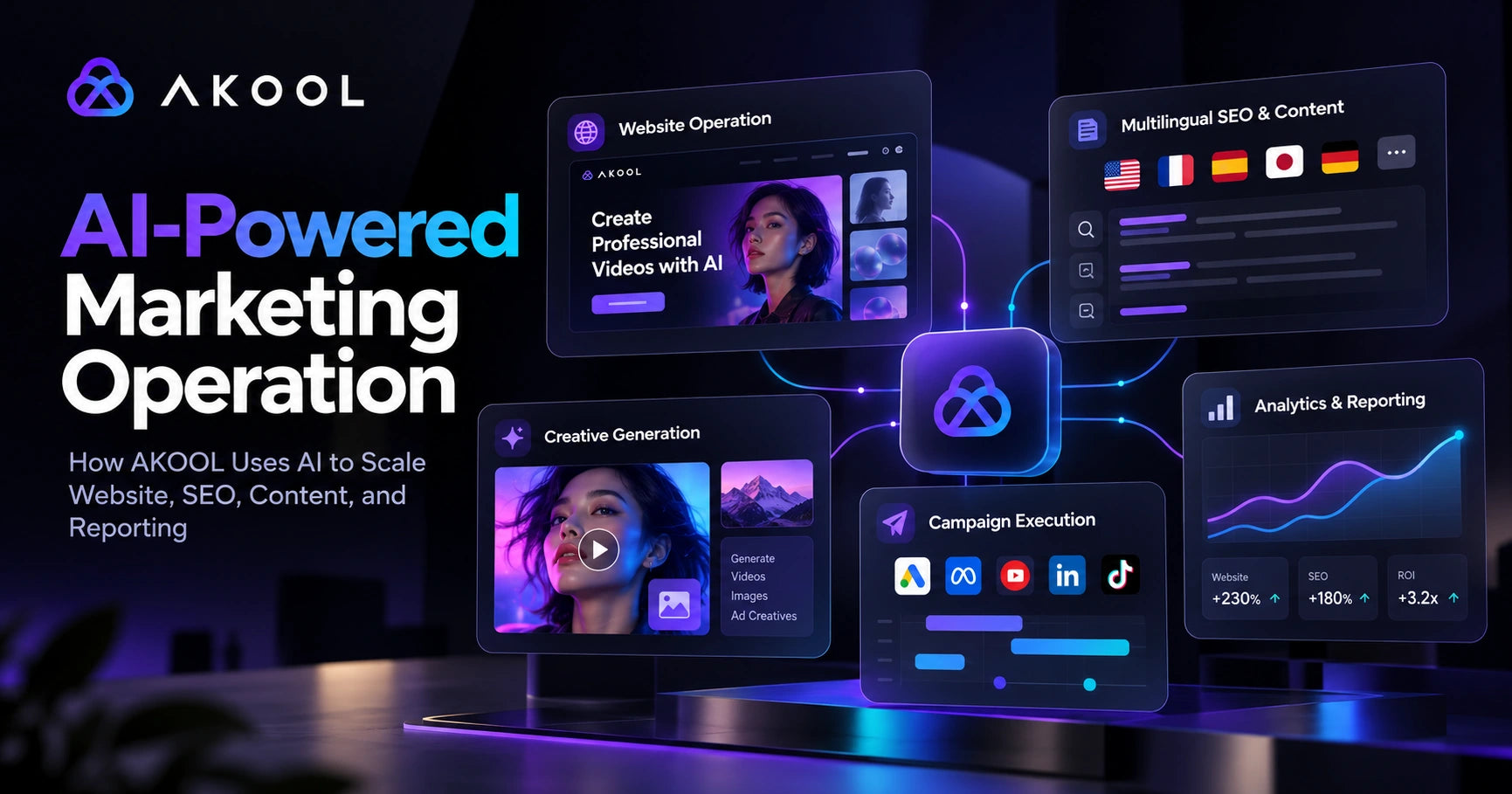

When people talk about AI in marketing, the conversation often starts with what a chatbot can generate: a headline, a blog draft, or a social post. At AKOOL, we're interested in something broader—and much more practical. What happens when AI becomes part of how a marketing team actually operates?
We build AI-powered creative technology, so it's natural that our marketing team experiments with AI ourselves. But the important part isn't using an impressive list of tools. It's connecting them to real work: improving our website, organizing content across languages, protecting brand quality, and creating a more consistent way to measure what happens next.
Our approach is still evolving. Some workflows are already in use; others are being tested or designed. Below is a candid look at what we've actually worked on, how we made decisions, and where we see the next opportunity.
Our approach in brief
- Connect AI to existing marketing systems. We work with Webflow and its CMS, rather than creating isolated mockups that never reach the website.
- Use the right tool for the task. ChatGPT supports website design and CMS workflows; Claude has supported structured multilingual SEO; AKOOL supplies creative generation capabilities.
- Build human review into execution. We document changes, check what teammates are working on, and separate publishing from drafting. Reporting helps us evaluate outcomes once enough data is available.
1. Website redesign: working inside the actual Webflow environment
Our website isn't a static project. The products evolve, the stories we want to tell change, and different audiences need different information. That leads to a steady stream of requests: improve a page's hierarchy, make the visuals more compelling, tighten the copy, reorganize a CMS-managed section, or make the experience feel more consistent across desktop and mobile.
We're using ChatGPT with Webflow's Model Context Protocol (MCP) tools for this kind of work. In practical terms, MCP allows an assistant to interact with supported functions in Webflow. Instead of stopping at “here's a suggestion,” we can inspect existing page structures and CMS content, make supported edits, and review the result in the system where the page lives.
What a real page-update workflow looks like
- Start with the existing page. We inspect the real content, layout, and CMS structure instead of rebuilding from a generic template.
- Describe the business or design problem. It might be a crowded hero, unclear navigation, weak imagery, too much text, or a section that doesn't match the rest of the site.
- Use AI to explore and implement improvements. ChatGPT can help refine page copy, section structure, and supported Webflow design or CMS changes.
- Compare the draft with the intended experience. We review desktop and mobile layouts, links, image relevance, brand details, and whether the changes affect existing SEO.
- Keep publication under human control. A page is not ready merely because an AI tool has finished editing it.
This has been particularly relevant to our ongoing work on Webflow-managed editorial and resource experiences. For example, when a section looks too busy or doesn't give the creative work enough room, the improvement isn't simply “make it prettier.” We have to reconsider which information matters first, how people will scan the page, and which components or CMS fields should remain consistent elsewhere.
The process is iterative: inspect, refine, review, and refine again. We've also learned to distinguish a standalone visual mockup from the actual CMS page. Both can be useful, but the live-site structure and final quality checks matter most.
There is a boundary here as well. Webflow MCP does not automatically solve every design challenge or replace custom development. The hard-coded sections of akool.com require a different technical approach, which we're still exploring.
2. Multilingual SEO: a detailed workflow, not just more generated content
Our SEO work provides a concrete example of why structured processes matter as much as the AI itself. AKOOL serves a global audience, and maintaining clear search content in multiple languages requires more than translating a paragraph and hoping for the best.
Using Claude, we worked through approximately 3,800 SEO field updates across English and eight additional languages. Those updates covered page titles, meta descriptions, headings, and image alt text. Rather than treating each edit as an isolated suggestion, we worked from the existing Webflow content and tracked what changed.
The work also went beyond metadata. We identified 20 articles overlapping around searches for “Top 5 AI video generator” and consolidated that material into four more focused guides, then translated them into eight languages. We also revised titles and added FAQs to selected Wan, AKOOL Live Camera, and Remaker comparison pages.
The review process mattered as much as the output
For the SEO changes, we recorded the original value, the proposed replacement, and the reason for it. A person reviewed each change before publication. When a teammate had unpublished work on a page, we held those updates back rather than risk overwriting their draft.
This gives us something more useful than a list of prompts: a record of decisions. We can see the language affected, understand why a field changed, and revisit the recommendation if a page needs further work. It's also a better starting point for coordinating with SEO partners who have different keyword or topic responsibilities.
The lesson is not that AI should publish thousands of edits without supervision. It's that a team can use AI to organize complex content work while maintaining editorial standards and a clear approval trail.
3. Content strategy: quality, consolidation, and clear ownership
One of the easiest ways to misuse AI in content marketing is to increase publishing volume without improving the experience for readers. We want to be more intentional than that.
Our consolidation project is a good example. Twenty similar articles may look like a lot of output, but if they repeatedly answer the same question, readers and search engines can struggle to understand which page is most useful. We chose to bring that overlapping material into four more focused guides, with a clearer purpose for each.
In our wider editorial work, AI can help organize research, produce working drafts, identify gaps, and prepare content for review. But our team still decides whether a topic fits the audience, whether the examples are accurate, and whether the finished article actually explains something valuable.
That distinction is central to how we want to operate. The goal isn't an automated publishing machine that creates endless content. It's a stronger editorial process that combines search intent, product knowledge, good storytelling, and human judgment.
4. Connecting the operational side with AKOOL's creative technology
There are two sides to a modern marketing workflow. One is operational: the systems that manage content, website updates, and distribution. The other is creative: the images, videos, and experiences people actually see.
The tools we use for those jobs are not interchangeable. ChatGPT and Webflow MCP help us work with website structure and CMS content. Claude has helped us manage structured SEO work. AKOOL supports the creative-production side through capabilities such as AI video generation, image generation, and avatars.
For a marketing team, creative AI matters because a compelling idea has to become something audiences can experience. A written brief can be explored visually; an image can become a moving scene; and different creative formats can be considered without starting every exploration from a traditional production pipeline. Our team's responsibility is still to choose the concept, voice, and final creative direction.
AKOOL MCP: a different connection for a different job
AKOOL also offers its own MCP-powered creative workflow. In a documented example, Claude Code acts as the conversational interface, invokes available AKOOL tools, and checks an image-to-video generation task. AKOOL performs the actual media generation. Our published Claude Code and AKOOL MCP guide explains the steps.
That is distinct from using Webflow MCP to manage pages. The two integrations connect AI assistants to different capabilities; they do not yet represent one autonomous, end-to-end marketing system. What they show is the direction of travel: AI becoming accessible inside specific stages of a professional workflow instead of sitting in a separate chat window.

As we develop our own marketing practices, that distinction keeps the narrative credible. We're demonstrating how different technologies can support one organization—not claiming that every capability has already been connected or that every campaign asset is made through the same workflow.
5. Human review is a feature of the process, not an afterthought
When an AI assistant can interact with a real content system, the standard for quality needs to go up, not down. A poor suggestion is easy to discard in a document. A published website error can affect search visibility, brand perception, or another teammate's work.
That's why our process includes reviews of the actual page, not only the generated copy. We check image relevance, mobile layouts, navigation, page links, SEO metadata, and whether changes are compatible with the existing design. We also keep unfinished teammate work out of the path of automated updates.
The marketing team sets direction and approves the public experience. SEO partners can recommend changes, while the people responsible for the relevant pages or technical systems evaluate and implement them. AI helps with the work between those decisions; it doesn't remove accountability.
A capable AI-enabled marketing team isn't defined by how many tasks it hands to a bot. It's defined by the quality of the judgment and the repeatability of the process around the tools.
6. Reporting: connecting implementation with the results
It's tempting to describe a large SEO project as a success the moment the updates are published. We think that misses an important step: measurement.
We've set up scheduled weekly and monthly reporting from Google Search Console, creating a consistent way to review performance after our SEO work. As data accumulates, we'll look at trends in clicks, impressions, queries, and page-level visibility to understand what deserves attention next.
The reporting schedule is in place, but we don't yet have a sufficient post-change period to draw reliable conclusions. We are not claiming traffic gains, ranking increases, time savings, or revenue impact from the work described here.
That is intentional. Implementation tells us what changed; ongoing reporting will help us judge whether the changes mattered. For a marketing team, both parts are essential.
7. Where we're going next
The next step is to make these individual workflows more connected and repeatable while preserving control over quality. We are exploring ways to prepare content from an approved topic backlog, bring reporting from tools such as HubSpot and social platforms into a more consistent review process, and extend AI-assisted work to parts of akool.com that are custom-coded rather than managed in Webflow.
Those are directions we're evaluating—not a claim that every proposed agent or integration is already running. We want the team to be able to test a workflow, understand its limitations, and then decide whether it earns a place in our regular operations.
What we have learned so far is that AI works best when marketers stay close to the work. We bring the customer perspective, product knowledge, creative judgment, and business priorities. AI helps us explore options, manage complexity, and act within the systems we already use.
At AKOOL, we're not simply adopting AI tools. We're learning how to build a marketing operation around thoughtful collaboration between people, creative technology, and connected systems—and we're putting those lessons into practice one workflow at a time.